



The complete guide
How to Choose a Travel Humidor That Actually Protects Your Cigars
The problem with carrying cigars loose
Every cigar smoker has done it once. You slide two cigars into a jacket pocket, head out for the evening, and by the time you sit down one has a split wrapper and the other has picked up a bend it will never lose. Or you throw a few in a bag for a weekend, and by Sunday they crackle when you roll them between your fingers.
Cigars have two enemies on the road. The first is physical damage. A cigar is tobacco leaf wrapped around more tobacco leaf, and it does not survive being pressed against a set of keys or a laptop edge. The second is dry air. A cigar that leaves a humidor at a comfortable humidity starts losing moisture the moment it hits an air-conditioned room, a plane cabin or a hot car.
A travel humidor fixes both. It is a hard, sealed container that gives each cigar its own space, holds a humidity level for a while, and lets you check that level without guessing.
How a travel humidor works
The idea is simple. A rigid outer shell absorbs any knocks. A close-fitting seal slows the exchange of air between the inside of the case and the room. Inside, your cigars sit in a controlled pocket of air that stays close to the humidity they were packed at.
That seal is only half the job. Air inside a closed case still dries out slowly, especially once you open and close it a few times. That is why most people add a small two-way humidity pouch or a gel disc. These release moisture when the air gets dry and absorb it when it gets too damp, holding things steady without any fiddling.
The hygrometer tells you whether it is working. A reading around 60 to 70 percent relative humidity is the range most smokers aim for. Below that, cigars start to get brittle and burn hot. Above it, they get sluggish and can taste muddy. With a dial in the lid you can glance, see where you are, and act before a good cigar is ruined.
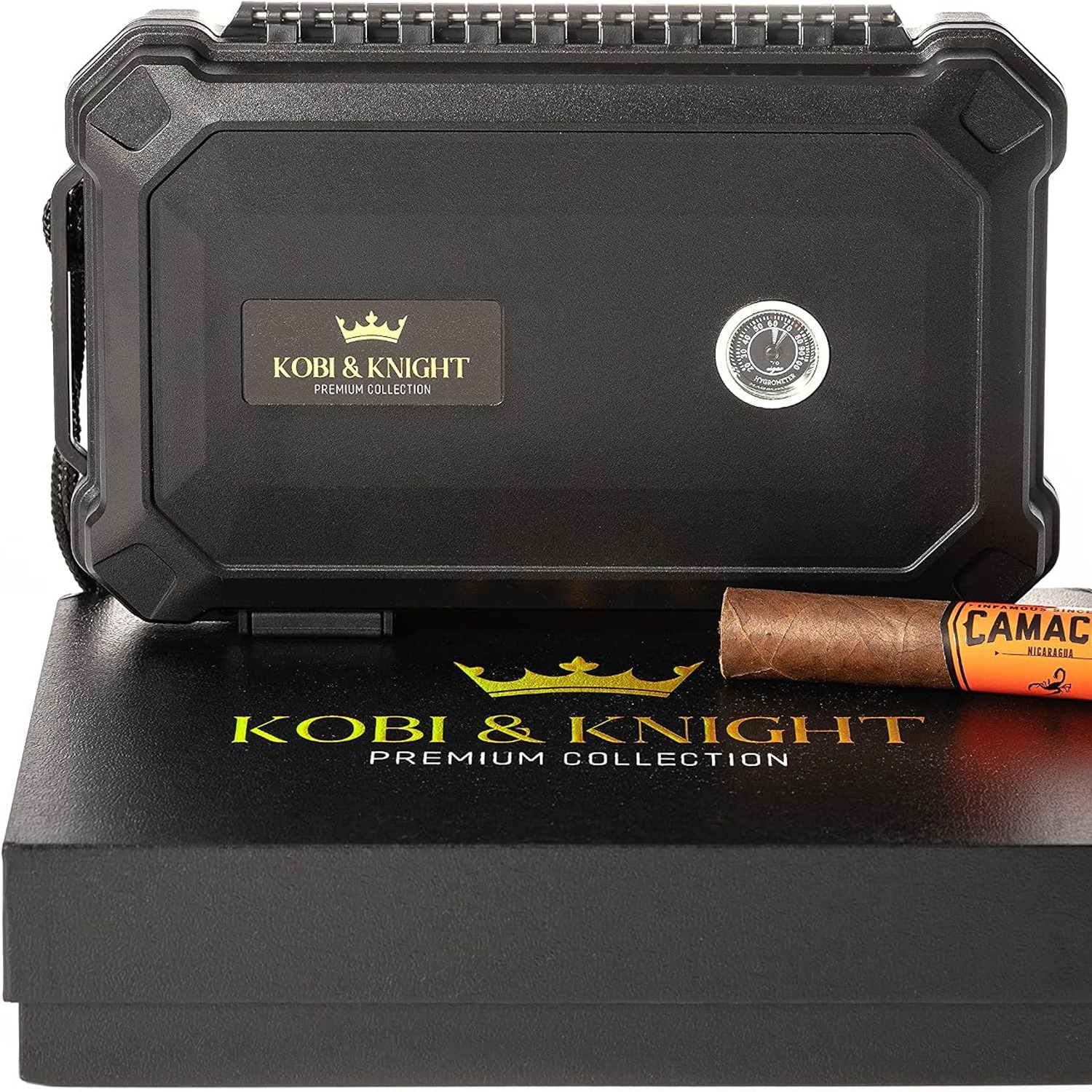
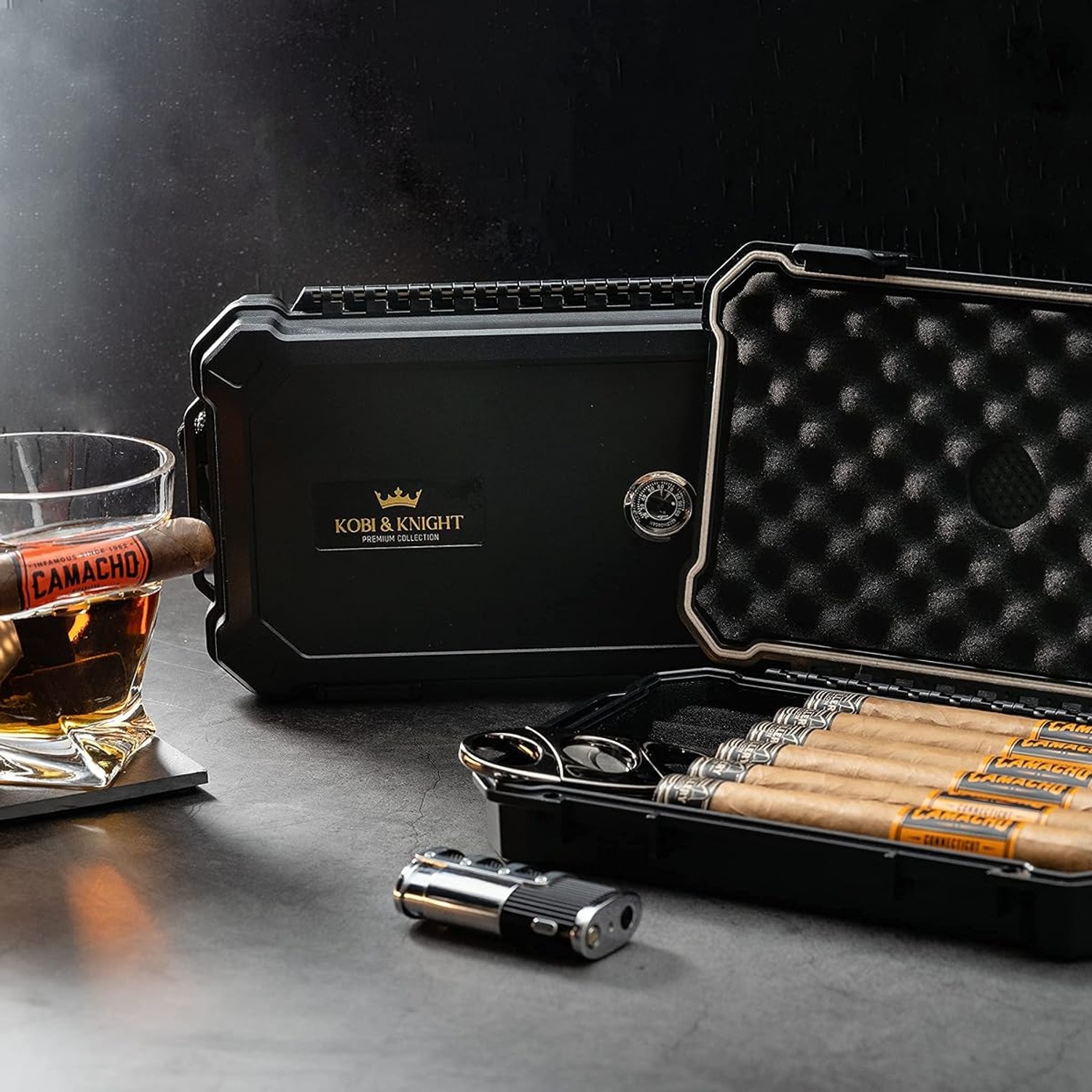
This Kobi & Knight case covers all three parts. The shell is an alloyed PC and ABS blend, the same family of plastics used for hard luggage. A hygrometer is built in. And at 22.86 x 15.24 x 4.45 cm, the inside is sized for up to six cigars, including longer 8-inch formats.
Who this suits
Frequent flyers get the most obvious benefit. A hard case survives being packed, repacked and shoved into an overhead locker. It also keeps cigars away from the dry cabin air for the length of a flight.
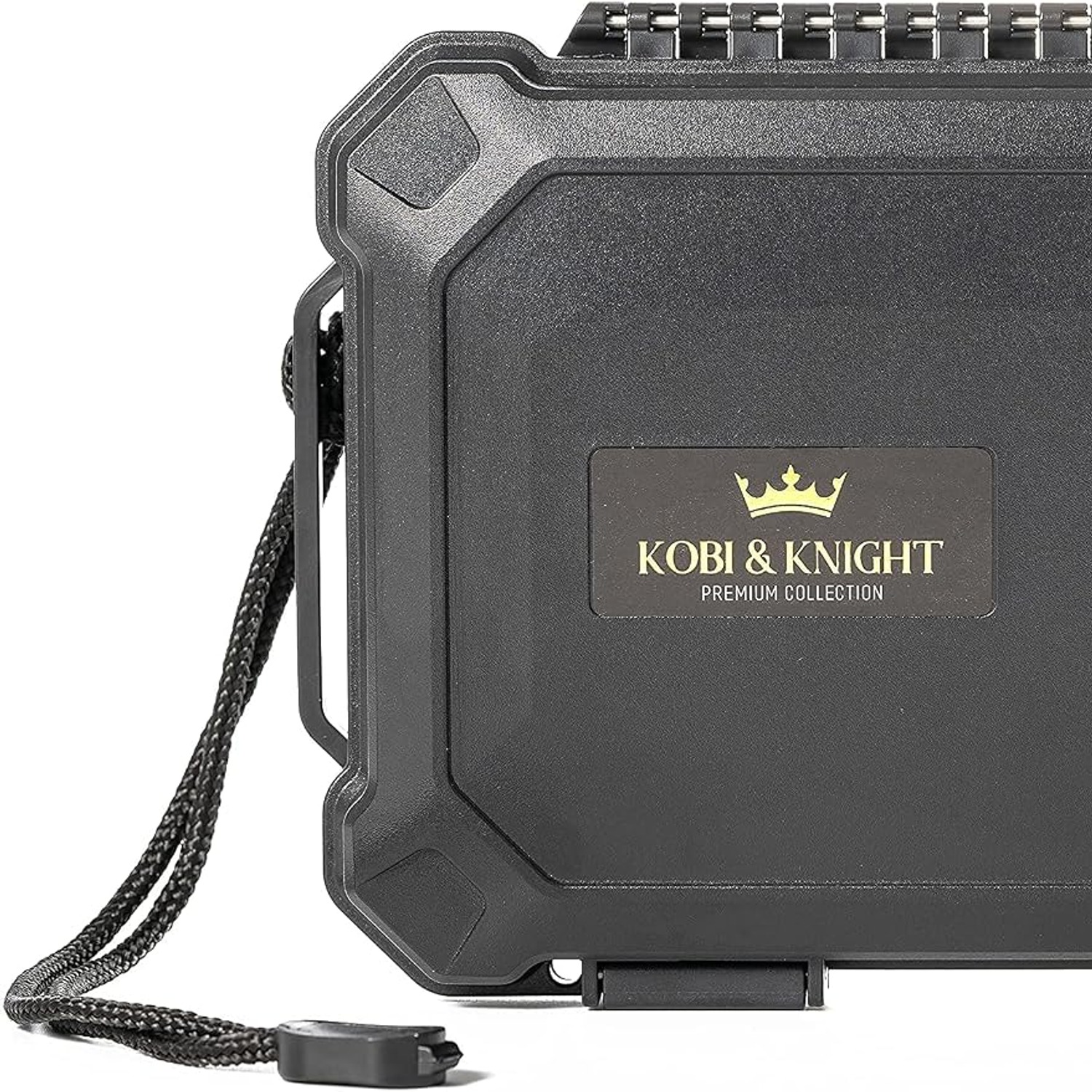
Golfers are the other big group. A round takes hours, and a cart ride is not kind to anything soft. The best golf cigar case is one you can drop in a bag pocket and forget about until you want it, and a lanyard means it hangs off a strap rather than disappearing to the bottom of the bag.
Then there is everyone who smokes outdoors: campers, anglers, boaters, people who spend weekends somewhere with no mains power and plenty of weather. The water and dust resistance matters more here than anywhere. A sealed shell is the difference between a smokeable cigar and a soggy one.
Occasional smokers also do well with a case like this. If you only light one up a few times a year, a full desktop humidor is overkill. A compact humidor with a pouch inside does the job for the handful of cigars you actually own.
How to choose
Start with capacity. Six is a sensible number for most trips. It covers a weekend comfortably, a long round of golf easily, and leaves room to share. Be realistic about ring gauge, though. Six slim cigars fit neatly, but if you mostly smoke 60-ring sticks you will carry fewer. Length is rarely the issue with a case sized for 8-inch cigars. Width usually is.
Then look at the shell. Soft leather cases look handsome but offer almost no crush protection. Thin plastic cases crack. A proper alloyed PC and ABS body is what you want if the case is going to live in a bag or a boot. If you want the best hard shell cigar case for rough use, rigidity is the thing to check first.
Check for a hygrometer. A case without one leaves you guessing, and guessing is how cigars get ruined. Even a basic dial tells you whether your humidity pouch is doing its job. If precision matters to you, cross-check it against a separate meter once and note the difference.
Think about carry. A lanyard sounds like a small thing until you are standing on a deck with a drink in one hand. Being able to hang the case off a strap or a rail saves you putting it down somewhere you will forget it.
Consider size against your luggage. Slim beats bulky. At 4.45 cm deep, this one lies flat in a carry-on rather than fighting for space. Weight is 649 g empty, which you will barely register.
Getting the humidity right before you go
Load the pouch first, not the cigars. Put your humidity media in the empty case, close it, and leave it for several hours or overnight. Check the hygrometer. Once the reading sits where you want it, add the cigars.
Doing it this way avoids a common mistake. If you load cigars and media at the same time, the case takes a while to settle, and you have no idea whether your cigars spent the first day in air that was too dry or too wet.
Try not to open the case more than you need to. Every opening swaps the conditioned air inside for whatever is in the room. If you are smoking two on a Saturday, take them both out at once rather than opening twice.
Replace humidity pouches when they go stiff. They are inexpensive, and a spent pouch is doing nothing except taking up space.
Looking after the case
Wipe the inside and outside with a soft cloth, dry or barely damp. Let it air out fully before you put cigars back in, because trapped moisture on a lining can cause problems over time.
Keep it out of direct sun and away from heat sources. A case left on a dashboard or next to a heater gets hot enough to dry cigars quickly, and sustained heat is not good for plastics either.
Avoid solvents and abrasive cleaners, especially near the hygrometer window, which scratches more easily than the shell. No dishwasher.
If you are putting the case away for a while, take the cigars out and store them in your main humidor, and leave the case open so the inside stays fresh.
As a gift
A travel humidor is one of the safer presents for a cigar smoker, because almost nobody buys one for themselves until they have ruined a few cigars first. It works whether the recipient has a cabinet full of boxes or just the occasional cigar at a wedding.
This one arrives in a presentation box, so it does not need wrapping gymnastics. If you want to make it feel complete, add a couple of humidity pouches and a cutter. Those two small extras turn a case into a kit.
The short version
A travel humidor exists to do two jobs. Keep cigars from getting crushed, and keep them from drying out. This case handles the first with a hard alloyed PC and ABS shell, and the second with a sealed body plus a hygrometer so you can see what is going on inside.
It holds up to six cigars, including longer formats. It measures 22.86 x 15.24 x 4.45 cm and weighs 649 g. It comes with a lanyard and ships in a gift box.
Add a humidity pouch, set it up the night before you travel, and your cigars will be in as good a shape when you light them as when you packed them. That is the whole point.